
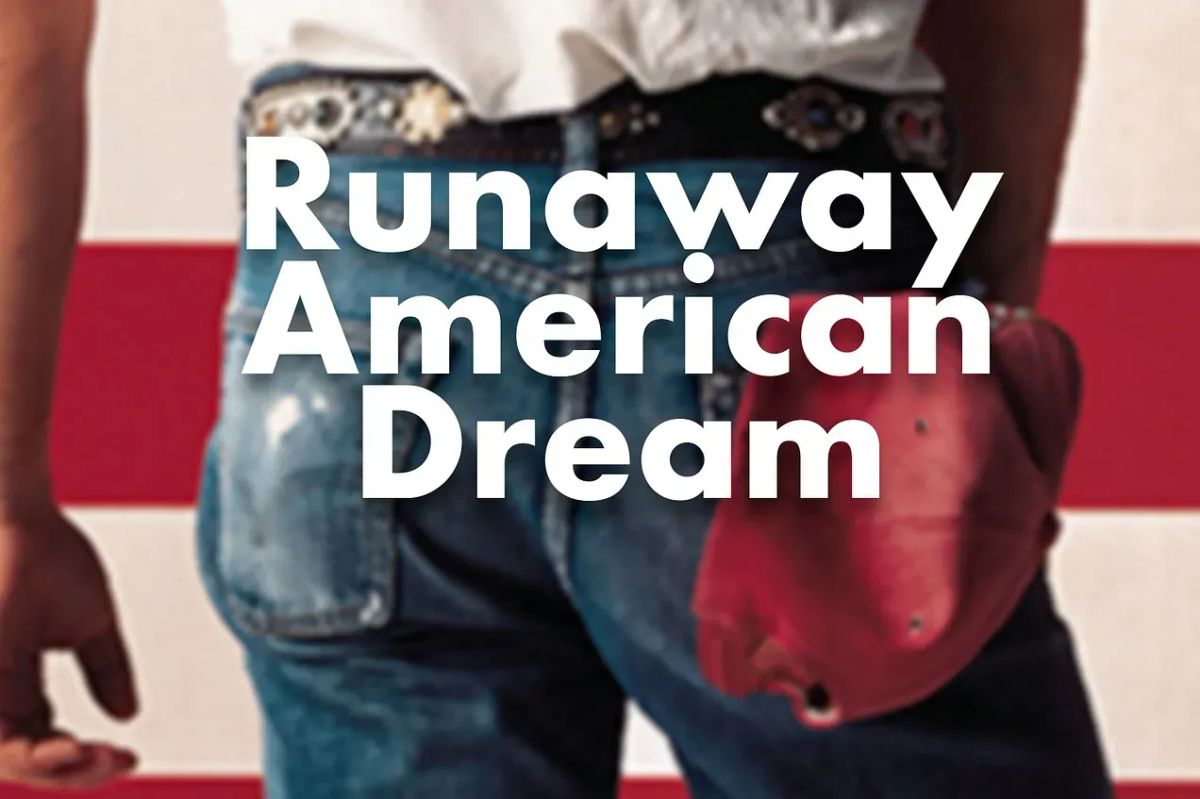
Runaway American Dream

This piece was originally published at Substack.
“Your flag flyin’ over the courthouse
Means certain things are set in stone.
Who we are, what we’ll do and what we won’t”
The above is a quote from Bruce Springsteen’s “Long Walk Home.” Appearing on Magic, The Boss’s 2007 album which spoke to the malaise of the latter days of George W. Bush’s presidency, the song resisted looking back at the mistakes made and instead looked toward the future — the long walk back to a more recognizable America.
That walk was fraught; it’s debatable whether the country every truly recovered from the Bush era before Trump came along. In any case, Springsteen is now seen as more political than ever before, speaking out openly and loudly against the lawless regime in Washington.
Doing so has drawn the 76-year-old rocker into the public spotlight even more than usual, and has reawakened conversations about Springsteen’s politics that have recurred since at least the mid-’80s, when Ronald Reagan famously misinterpreted the lyrics to “Born in the U.S.A.,” and was corrected by the musician himself.
In taking on Trump directly, Springsteen has become the center of attention on social media. Trump has been posting petulant rants about Springsteen, urging his supporters to boycott the musician’s sold-out concerts and accusing the musician of having plastic surgery.
“I absolutely couldn’t care less what he thinks about me,” Springsteen told Time in 2025. “He’s the living personification of what the 25th Amendment and impeachment were for. If Congress had any guts, he’d be consigned to the trash heap of history.”
While Trump floods Truth Social with his venom, Springsteen’s concerts (and his comments about Trump) go over a lot better on other platforms. Over on Threads, each new Springsteen concert floods the algorithm with cell phone footage and fans gush over his high-energy, three-hour shows.
So — what is it about Bruce Springsteen in particular that has created all this buzz? Yes, “Streets of Minneapolis” was a huge hit, but numerous other major artists, from Dave Matthews to U2, have released anti-ICE and anti-Trump songs in the recent past. Springsteen’s own first anti-Trump anthem, 2020’s “Rainmaker,” also didn’t make that much of a dent.
A lot of it comes down to Springsteen’s public identity —or his brand, if you’re feeling spicy. He’s an everyman type whose songs tell the story of lovable losers, desperate people living on the fringes, and people facing challenges well outside of their control. They’re relatable in a way that more obviously political artists are generally not.
“I spent most of my life as a musician measuring the distance between the American dream and American reality,” Springsteen said back in 2008, when he was campaigning alongside Barack Obama.
It’s a line Springsteen has revisited periodically ever since, and with the rise of authoritarianism and the normalizing of profoundly racist and xenophobic policies and attitudes, one could argue there has never been a more urgent time to chart that distance.
Springsteen, in his flannels and leather jackets, embodies white, middle-class cool in a way that Republicans desperately want to own. He got most of his drinking, drugs, long hair, and other outward indicators of social nonconformity out of his way before he was famous, and is the godfather of the kind of heartland rock/dad rock that bridges the gap between country and classic rock.
For years, people lacking in media literacy have been trapped in a Groundhog Day-style loop of being surprised by Springsteen’s left-leaning politics…
- The U.S. version of Springsteen’s Land of Hope and Dreams Tour isn’t the first time Trump has lashed out after Springsteen criticized him onstage. That comment in the Time interview was responding directly to the President’s vitriol after Springsteen made nearly identical remarks at European tour dates late last year.
- Of course, Springsteen also played some fundraisers for Kamala Harris. He toured quite a bit with Obama (who came out to Springsteen’s “The Rising” after being elected) — and after Obama’s presidency, the pair would host Renegades: Born in the U.S.A., a podcast that explored their mutual admiration for one another and their attitudes about the American experiment.
- When Springsteen joined the Vote For Change tour in 2004, Republicans balked at the working-class hero who made “Born in the U.S.A.” and “Glory Days” supporting a — gasp! — liberal. A few years later, a quote from 2004 Democratic presidential candidate John Kerry would serve as the backbone for Springsteen’s song “Last to Die.”
- Before that, conservatives got big mad when Springsteen spoke out against the police killing of Amidou Diallo, an unarmed Black man shot 41 times by off-duty police officers who claimed they mistook Diallo’s wallet for a gun. NYPD officers refused to provide concert security when Springsteen wouldn’t back down from performing the song at Madison Square Garden, just miles from the site of Diallo’s killing.
- There was the time anti-immigration activists and other right-wing racists got angry that Springsteen did a whole album — 1995’s The Ghost of Tom Joad — that centered on issues that impacted migrant workers and the poor whites who exist in their orbit. The title track, a reference to John Steinbeck’s The Grapes of Wrath and Woody Guthrie’s song “Tom Joad,” was covered by Rage Against the Machine — another band that the right periodically rediscovers aren’t actually on their side and can’t understand why.
- Speaking of Guthrie, Woody’s beloved anthem “This Land is Your Land,” along with Edwin Starr’s “War,” both appeared on Springsteen’s record-breaking 1986 live album, in case anybody was wondering where Springsteen stood back then. Of course, they might have been confused. After all, the whole kerfuffle with Reagan had just happened over Born in the U.S.A.
- One can understand why there was confusion over “Born in the U.S.A.” After all, it had only been about a decade since Springsteen’s “Lost in the Flood,” which spoke to the same themes of a soldier returning home after Vietnam to feel alienated by an America he didn’t recognize.
- That was 1973, though — barely a year after Springsteen, even before he had a record deal, had performed at a fundraiser for Democratic presidential nominee George McGovern in 1972.
Springsteen, as seen above, preaches unity over division. He has met socially with politicians from both parties, most notably former New Jersey governor Chris Christie, a Trump sycophant who is (or at least was in the past) a huge Springsteen fan.
It isn’t just Springsteen’s anti-Trump message — or even the way his long history in politics creates a perfect engagement-bait storm — that makes those concert clips so compelling, though.
First, there’s the obvious: the man makes some really fucking catchy music. He’s a great songwriter and widely regarded as one of the best live acts in rock history.
But maybe the more important thing is in his stage presence. Springsteen is a master storyteller, both in his music and onstage. Springsteen, who earned a special Tony Award in 2018 for his residency on Broadway, has always been fascinated with using the structure of an album to tell a larger story made up of smaller stories. In recent years, he has taken to doing the same with concerts.
“I knew right there that my gut reaction to that footage was the film gods pointing me in a direction of the importance of the setlist — the importance of Bruce the storyteller — and then looking at the songs, and what they carry,” filmmaker Thom Zimny told me in 2024, when we spoke about his Springsteen documentary Road Diary. “There are themes there: themes of friendship, redemption, an understanding of your present day, the past.”
During that tour, Springsteen had a setlist that rarely changed very much, and he used it to explore those themes in a very specific way, using prepared remarks about the losses of friends and loved ones and anecdotes about his life and that of the band. It’s an approach that mirrors what you can see both in Springsteen on Broadway — available on CD, or to stream on Netflix — and in Springsteen’s earlier appearance on VH1 Storytellers.
This time around, Springsteen’s story is one of despair, hope, and action. Before closing out each show in the Land of Hope and Dreams tour with a cover of Bob Dylan’s “Chimes of Freedom,” Springsteen introduces it with a monologue that quotes civil rights leader John Lewis and urges fans to “say something, do something, help.”
Springsteen, no stranger to writing songs that wring hope out of hopeless situations, is the perfect artist to help steer Americans through dark waters right now. He isn’t just singing about ICE and Trump and police violence and Tom Joad. He’s also taking breaks in between to sing songs of hope, joy, triumph, and love.
“It ain’t no sin to be glad you’re alive,” from “Badlands,” is one of Springsteen’s greatest lyrics, but in the context of this year’s politically-charged setlist, it hits harder than usual.
In between the songs of pain and protest, Bruce’s straightforward rockers serve a purpose: they are a reminder of better days — a reminder of what we fight for.
“It ain’t no sin go be glad you’re alive” can also serve as a reminder that the scolds who will try to guilt you for self-care are missing the forest for the trees.
Springsteen, of course, is full of these turns of phrase. “Born to Run,” the song that made him famous, sees its heroes “sweat it out on the streets of a runaway American dream.” In “Thunder Road,” it’s “a town full of losers, and we’re pulling out of here to win.” In “Darkness on the Edge of Town,” Springsteen’s narrator says he’ll “pay the cost for wanting things that can only be found in the darkness on the edge of town.”
For over 50 years, Bruce Springsteen has been singing about people who face impossible odds. They don’t always win, and sometimes their stories are downright tragic, but they persist. That’s a huge part of why seeing him rail against Trump before launching into “My City of Ruins” works so effectively.
In 2026, Springsteen isn’t really charting the distance between the American dream and the American reality anymore. He’s charting the distance between the America most of us believe in, and the one into which Trump and his cronies are trying their best to transform it. Bruce is compelling, in part, because he refuses to let hopelessness win — and, unlike our spineless representatives in Congress, he refuses to be deterred or intimidated by Trump’s ravings.